Epoch
One complete pass through the entire training dataset during model training.
An epoch represents a full cycle where the learning algorithm has processed every example in the training dataset once. Multiple epochs are typically needed for a model to learn patterns effectively, with the number of epochs being a key hyperparameter.
Basic Definition
-
Complete Dataset Traversal means that during one epoch, every single training example has been used exactly once to update the model's parameters. If a dataset contains 10,000 examples, one epoch involves processing all 10,000 examples.
-
Training Cycle Unit provides a standardized way to measure and compare training progress across different datasets and model architectures, regardless of dataset size or batch configuration.
-
Parameter Update Frequency determines how often the model's weights are adjusted based on the learning rate and optimization algorithm being used.
Relationship to Batches
-
Batch Processing divides the dataset into smaller chunks called batches that are processed together. One epoch consists of multiple batch processing steps until the entire dataset is covered.
-
Iterations per Epoch equals the total number of training examples divided by the batch size. A dataset of 1,000 examples with a batch size of 50 requires 20 iterations to complete one epoch.
-
Gradient Updates occur after each batch, meaning the model's parameters are updated multiple times within a single epoch, with the frequency depending on the chosen batch size.
Training Progression
-
Multi-Epoch Training is standard practice, with models typically trained for dozens, hundreds, or even thousands of epochs depending on the complexity of the task and dataset size.
-
Convergence Monitoring tracks how model performance changes across epochs, looking for signs that the model is learning effectively or has reached optimal performance.
-
Early Stopping uses epoch-based monitoring to halt training when performance on validation data stops improving, preventing overfitting and saving computational resources.
What is the right number of epochs?
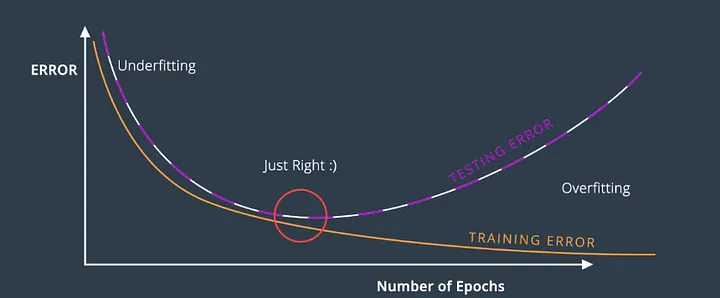
The number of epochs is not that significant. more important is the validation and training error. As long as these two error keeps dropping, training should continue.
For instance, if the validation error starts increasing that might be an indication of overfitting.
You should set the number of epochs as high as possible and terminate the training when validation error start increasing
Learning Dynamics
Initial Epochs often show rapid improvement as the model learns basic patterns and relationships in the data, with large changes in loss functions and accuracy metrics. Middle Epochs typically demonstrate steady, gradual improvement as the model fine-tunes its understanding and optimizes parameter values.
Later Epochs may show diminishing returns or signs of overfitting, where training performance continues improving but validation performance plateaus or degrades.
Hyperparameter Considerations Learning Rate Scheduling often adjusts the learning rate based on epoch number, starting with higher rates for faster initial learning and reducing rates in later epochs for fine-tuning.
Epoch Budget represents the computational resources available for training, with researchers often needing to balance thoroughness with practical time and cost constraints.
Validation Frequency determines how often model performance is evaluated on held-out data, commonly done after each epoch or every few epochs.
Practical Examples
-
Image Classification might require 100-200 epochs to train a CNN on a dataset like CIFAR-10, with each epoch processing all 50,000 training images once.
-
Language Model Training can involve thousands of epochs when working with large text corpora, as the model gradually learns complex linguistic patterns and relationships.
-
Neural Machine Translation typically requires several hundred epochs to achieve good performance, with careful monitoring to prevent overfitting to specific language pairs.
Monitoring and Visualization
-
Training Curves plot metrics like loss and accuracy against epoch number, providing visual feedback about learning progress and potential issues.
-
Epoch Logs record detailed statistics for each epoch, including training loss, validation accuracy, learning rates, and timing information.
-
Checkpointing saves model state at regular epoch intervals, enabling recovery from failures and comparison of performance across different training stages.
Common Patterns
-
Overfitting Detection appears when training metrics continue improving across epochs while validation metrics stagnate or worsen, indicating the model is memorizing rather than generalizing.
-
Underfitting Signs include poor performance on both training and validation data even after many epochs, suggesting the model needs more capacity or different architecture.
-
Learning Rate Issues manifest as erratic performance across epochs (too high) or extremely slow improvement (too low), requiring adjustment of optimization parameters.
Modern Considerations
Large Dataset Training with millions or billions of examples may require only a few epochs due to the massive amount of information processed in each complete pass.
Transfer Learning often needs fewer epochs when fine-tuning pre-trained models, as the model starts with existing knowledge rather than random initialization.
Distributed Training must coordinate epoch counting across multiple machines or GPUs, ensuring consistent training progress measurement in parallel computing environments.
Best Practices
- Validation After Each Epoch provides regular feedback about generalization performance and helps identify optimal stopping points.
- Learning Rate Decay gradually reduces the learning rate as epoch count increases, helping models converge to better solutions.
- Model Checkpointing saves the best-performing model based on validation metrics rather than simply the final epoch, ensuring optimal model selection.
- Epochs provide the fundamental rhythm of machine learning training, offering a natural way to structure the learning process, monitor progress, and make decisions about when models have learned enough to be useful for their intended applications.