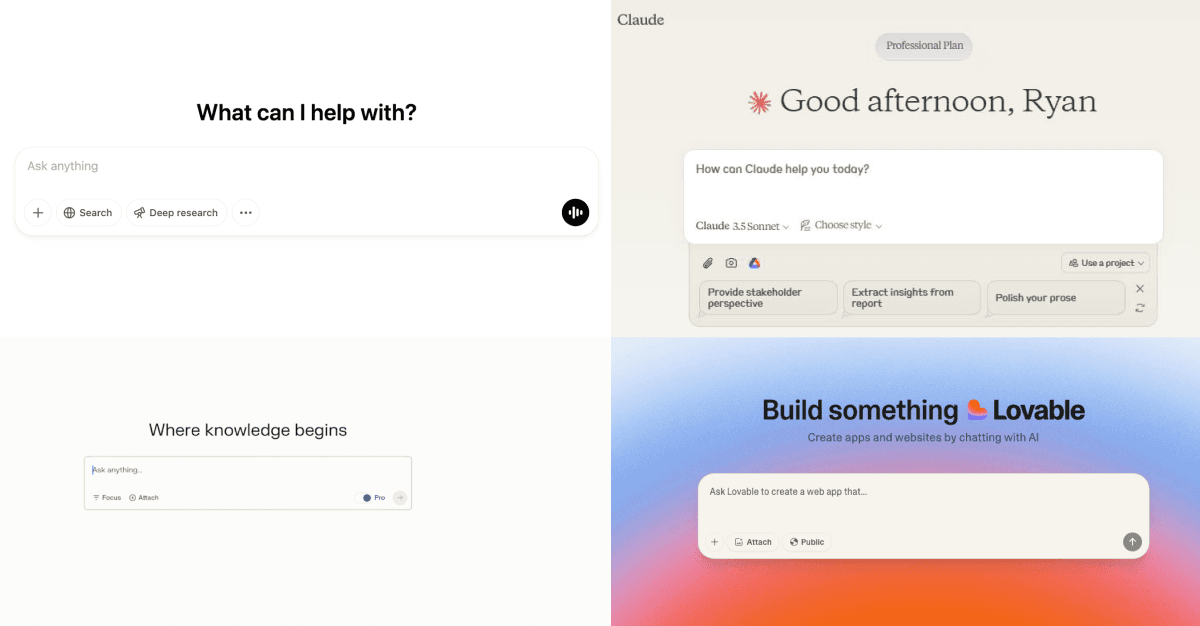
Chatbot
An AI program designed to simulate conversation with human users.
Chatbots use natural language processing to understand user inputs and generate appropriate responses. They range from simple rule-based systems following predefined scripts to sophisticated AI models that can engage in complex, contextual conversations.
Chatbots produce powerful interactions with users to help business processes, gain information, and even act as a personal assistant.
Types of Chatbots
1. Rule-Based (Menu/Button) Chatbots
How they work: Operate on pre-defined rules or decision trees. Example: "Press 1 for billing, 2 for support." Best for: Simple queries and structured conversations. Limitations: Can't handle complex or unexpected input.
2. AI-Powered (NLP) Chatbots
How they work: Use Natural Language Processing (NLP) to understand and respond in human-like ways. Example: ChatGPT, Google's Dialogflow, IBM Watson Assistant. Best for: Complex conversations, customer service, virtual assistants. Limitations: May require training and fine-tuning; prone to hallucination in open-ended settings.
3. Hybrid Chatbots
How they work: Combine rule-based logic with AI/NLP for better flexibility and accuracy. Example: A bot that starts with menu options but can understand typed questions. Best for: Businesses that want the safety of rules but the power of AI.
4. Voice-Enabled Chatbots (Voice Assistants)
How they work: Use speech recognition and synthesis (e.g., ASR + TTS). Examples: Amazon Alexa, Google Assistant, Apple Siri. Best for: Hands-free interaction, smart devices, accessibility. Limitations: Heavily dependent on accurate speech recognition.
5. Social Media/Messaging Chatbots
How they work: Integrated into platforms like Facebook Messenger, WhatsApp, or Slack. Examples: Facebook Messenger bots, Telegram bots. Best for: Marketing, customer engagement, lead generation. Limitations: Platform-dependent features and constraints.
6. Contextual Chatbots
How they work: Use machine learning and context awareness (like user history or session memory). Examples: Advanced virtual agents with memory. Best for: Personalized support, long-term engagement. Limitations: Require more development effort and data management.
7. Transactional Chatbots
How they work: Help users complete tasks like booking, ordering, or checking status. Examples: Airline booking bots, food delivery bots. Best for: E-commerce, travel, banking. Limitations: Limited scope; task-specific.
History of Chatbots
The first chatbot, ELIZA (opens in a new tab), was by Joseph Weizenbaum in the 1960's at MIT. It supposedly had been created to demonstrate how superficial human to computer communications was at that time. But, when it was put on personal computers, humans found it quite engaging. In 1972, PARRY was introduced by Kenneth Colby with the same rules as Eliza.
During the 90's and early 2000s there was a rise of scripted or rule based allowing ysers to interact with a chatbot with specicic responses.
In 2009, WeChat created a chat for it's end-users, and one year later in 2010 Apple introduced Siri, followed by Google Now in 2012. During this time, we additionally saw the first in-app messender with Intecom, allowing users to get product support.
In 2022, we saw a large leap forward with the introduction of ChatGPT, which uses large language models (LLMs) such as GPT-4o along with other multimodal models to generate human-like responses in text, speech, and images.
Challenges: Understanding context and nuance, maintaining conversation flow, handling ambiguous queries, avoiding inappropriate responses, and providing accurate information.